
The Push/Pull Force Problem: What It Is and Why It Matters
Posted by Colson Group on July 20, 2026
A number most facilities don't measure - but feel every day.
In Part 1 of this series, we looked at why manual cart movement is becoming a more significant workforce safety issue - driven by injury data, an aging workforce, and labor shortages that concentrate strain on fewer people.
This article gets more specific: what push/pull force actually is, what determines it, and why understanding it matters for anyone who specifies, selects, or oversees the equipment workers use to move loads through a facility.
What Push/Pull Force Means
Push/pull force is the amount of physical effort required to initiate and sustain movement of a loaded cart. It's measured in pounds of force and it varies depending on the load, the equipment, and the operating environment.
There are two distinct force events in any cart movement:
- Initial push force - the force required to start a stationary cart moving from rest. This is always higher than sustained force, because overcoming static friction requires more energy than maintaining motion. For a heavily loaded cart on a hard floor, initial push force can reach 50 to 100+ pounds for a single worker.
- Sustained push force - the force required to keep the cart in motion across the floor. Lower than initial force, but applied continuously across the full distance of each trip.
The combination of both - high initial force repeated many times per shift, with sustained force in between - is what creates the cumulative strain profile that leads to musculoskeletal injuries over time.
Research associates 9–18% of low back injuries specifically with pushing and pulling tasks. Overexertion as a category accounts for 72% of all back strains in the workplace.
What Actually Determines Push/Pull Force
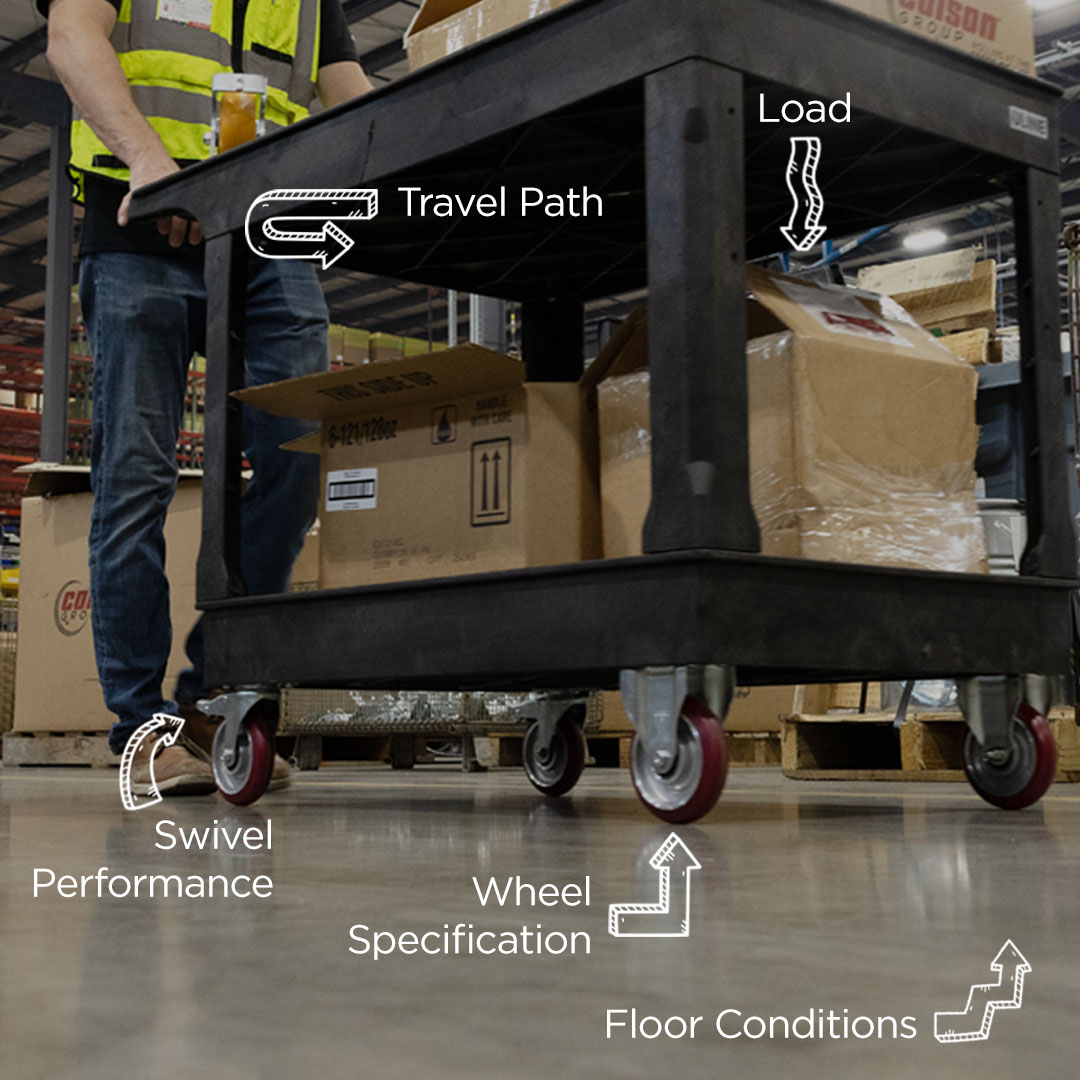 Push/pull force isn't fixed. It's governed by a set of interacting variables - and understanding which of those variables are controllable is the starting point for reducing it.
Load weight is the most obvious factor. Heavier loads require more force to move. But load weight is often determined by the operational requirements of the task, not by equipment design. It's typically not the most tractable variable.
What is controllable - and directly influenced by the mobility specification - is the resistance the cart generates as it moves.
Wheel diameter affects rolling resistance. Larger-diameter wheels roll more easily over surface irregularities because they encounter obstacles at a shallower angle. A small-diameter wheel that has to climb a floor joint or a seam must redirect more force to do it; a larger wheel rolls over the same feature more smoothly. Under the same load, a larger-diameter wheel consistently produces lower rolling resistance.
Wheel compound affects the load distribution and energy absorption at the contact point. Softer compounds deform slightly under load, increasing the contact patch and reducing peak contact pressure - which translates to lower rolling resistance on hard floors. The tradeoff is that very soft compounds can increase resistance on soft or uneven flooring by deforming into surface variations. Matching compound to floor type is a meaningful specification decision.
Swivel geometry and bearing quality govern the resistance generated when a cart changes direction. In most facilities, a significant portion of each trip involves direction changes - exiting a storage area, navigating a corridor junction, positioning at a workstation. Each direction change requires the swivel mechanism to rotate under load. Poor swivel geometry or worn bearings generate resistance at every turn that workers feel as increased effort, even when the cart is lightly loaded.
Floor surface is a variable the specification has to work with rather than around. Expansion joints, floor drains, threshold transitions, ramps, and flooring type variations all create force spikes that a well-matched caster absorbs more effectively than a poorly-matched one. The specification should account for the actual floor conditions the cart will travel - not idealized lab conditions.
The difference in required push force between a well-specified and a poorly-specified caster on the same cart, under the same load, can be substantial. It's one of the most controllable variables in the facility's physical strain picture.
Why This Is A Specification Decision, Not Just A Maintenance Decision
Many facilities address push/pull force reactively - through caster replacement after wear, lubrication schedules, and periodic maintenance. These are necessary practices, but they address the degradation of an existing specification, not the quality of the specification itself.
A cart with a well-matched caster specification - wheel diameter, compound, swivel geometry, and load rating all selected for the actual operating environment - will produce lower push/pull force from the first use, maintain that performance longer, and produce measurably less strain on the workers using it across a full shift.
Designing ergonomic mobility systems requires meeting four constraints simultaneously: reducing required push/pull force, supporting long-duration repeated use across full shifts, accommodating reduced worker strength in an aging workforce, and maintaining maneuverability in constrained facility layouts.
The caster specification is the primary mechanism for addressing all four of those constraints at the equipment level.
What Comes Next In This Series?
In Part 3, we look at what happens when the caster specification alone isn't enough to bring push/pull force within safe limits - and how powered retrofit mobility extends what's achievable without replacing existing cart infrastructure.